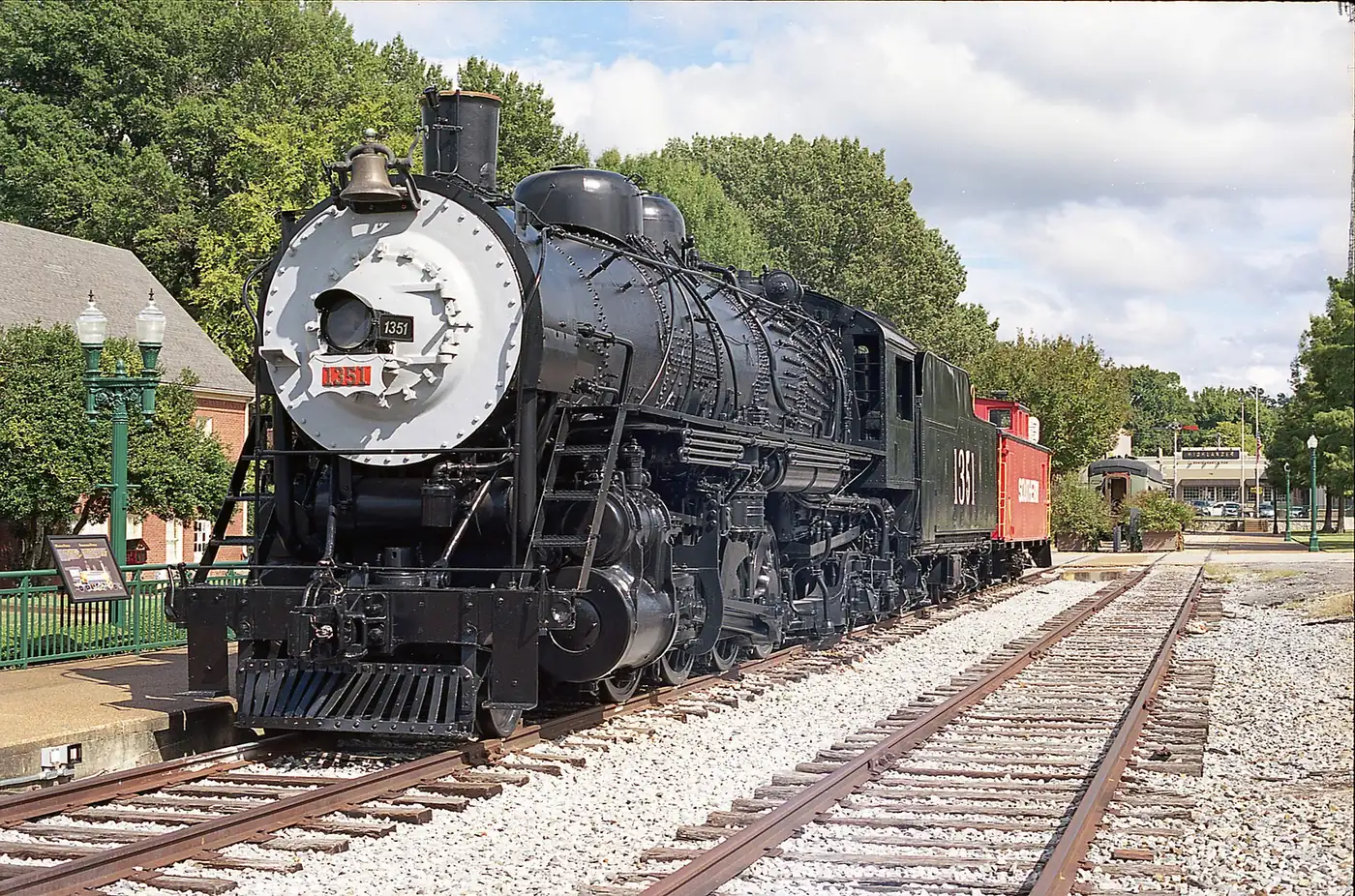
Collierville was incorporated in 1850 and rebuilt around its Town Square after the Civil War. Its 10 National Register listings, the Morton Museum and Frisco 1351.
Last checked Oct. 17, 2026. History comes from the Morton Museum of Collierville History’s town history, about and Frisco 1351 pages; listings from the National Park Service’s National Register of Historic Places data (May 22, 2026, file); preservation details from the town’s Historic Preservation Program.
Collierville began as “The Town of Collier,” 150 acres that land speculator Jessie R. Collier advertised for sale in the Memphis Enquirer in 1836, and was incorporated when the Shelby County Court accepted its petition on Feb. 7, 1850, according to the Morton Museum of Collierville History (196 N. Main St., 901-457-2650, free, 10 a.m. to 4 p.m. Tuesday through Saturday). Nearly destroyed in the Civil War, it was rebuilt around the Town Square, which anchors today’s Collierville Historic District, listed on the National Register in 1990.
Who to call
- Morton Museum of Collierville History: 901-457-2650, 196 N. Main St.
- Historic District questions and Certificates of Appropriateness: Planning Division, 901-457-2360
- Main Street Collierville (downtown preservation nonprofit): 901-853-1666
A short timeline
- 1818: After the Chickasaw cession in January, the Tennessee legislature creates Shelby County two months later.
- 1836: Jessie R. Collier advertises “The Town of Collier for Sale”; a post office follows, and the name is believed to have become Collierville.
- Feb. 7, 1850: the Shelby County Court accepts Collierville’s petition to incorporate.
- March 27, 1857: the Memphis and Charleston Railroad, the first to link the Atlantic to the Mississippi River, opens through Collierville. By 1860 the town’s population doubles to 500.
- Aug. 17, 1861: about 80 local men, the Wigfall Grays, join Confederate service as Company C, 4th Tennessee Infantry.
- June to August 1863: 123 formerly enslaved refugees from Collierville and nearby join Companies G and I of the 2nd West Tennessee Infantry, a U.S. Colored Troops regiment.
- Oct. 11, 1863: the Battle of Collierville. Confederate Brig. Gen. James R. Chalmers attacks the Union fort; a train carrying Maj. Gen. William T. Sherman arrives from Memphis mid-battle.
- After the war: with only three structures left standing by some reports, Harrison Irby and Virginius Leake buy 90 acres beside the railroad and sell lots, creating the Town Square. By 1877 the population reaches 1,031.
- 1878: yellow fever spreads from Memphis; by October fewer than 200 residents remain.
- 1903: Bellevue Female College, founded in 1879, becomes Collierville High School.
- 1934: Swift and Company opens a cheese plant, and Collierville is called the “Cheese Making Capital of West Tennessee”; a Cheese Carnival runs 1934 to 1940.
- 1950 to 1983: the “World-Famous Wonder Horse” is made at the Wonder Products factory in town.
- 2012: the Morton Museum opens in the former Collierville Christian Church.
National Register of Historic Places
The National Park Service’s data lists 10 Collierville properties:
| Property | Address | Type | Listed |
|---|---|---|---|
| Greenlevel | 853 Collierville-Arlington Road S. | Building | March 6, 1987 |
| Crisscross Lodge | 10056 Poplar Ave. | Building | April 6, 1989 |
| Collierville Historic District | Roughly N. and S. Rowlett, Poplar and Walnut streets | District | March 12, 1990 |
| John M. Fleming Home Place | 1545 S. Byhalia Road | District | Dec. 6, 1990 |
| John W. Thomas House | 245 W. Poplar Ave. | Building | March 29, 1991 |
| J.W. Houston House | 259 S. Center St. | Building | March 29, 1991 |
| Joseph A. Campbell House | 215 South St. | Building | March 29, 1991 |
| Jack Dudney House | 90 W. Poplar Ave. | Building | March 29, 1991 |
| John B. McFerrin House | 156 W. Poplar Ave. | Building | March 29, 1991 |
| Davis Charles House | 1291 Winchester Road | Building | May 8, 2017 |
Changes to buildings in the town’s H-1 historic overlay need a Certificate of Appropriateness from the Historic District Commission, which has issued more than 300 of them.
Places to visit
- Morton Museum of Collierville History, 196 N. Main St.: in the 1873 Collierville Christian Church, a Gothic Revival frame building whose tower held the largest bell in Shelby County, 800 pounds. The Morton family gave the building to the town in 2008. Permanent and temporary exhibits, a community art gallery and a reading room; always free, 10 a.m. to 4 p.m. Tuesday through Saturday, closed Sunday, Monday and holidays. Its online collection is on PastPerfect.
- Frisco 1351 and the train cars on the Town Square: a 1912 American Locomotive Company steam engine, rebuilt as No. 1351 in 1943, retired in 1952 and brought to Collierville in 1992; a rebuilt Seaboard Air Line business car painted in Southern Railroad colors; and caboose NKP 749, built in 1949.
- Town Square Park, 96 Center St., with its gazebo and pavilion.
- Depot Visitors Center, 125 N. Rowlett St., on the square, where the town hands out greenbelt maps.
What this means for you
- Start at the Morton Museum; it is free and on the square.
- Own a house in the historic district? Talk to the Planning Division before exterior work.
- Research a family or a building through the museum’s finding aids and online collection.
More guides: population, things to do this month and Christmas parade and tree lighting.
Frequently asked questions
When was Collierville founded?
Land speculator Jessie R. Collier advertised lots as ‘The Town of Collier’ in 1836, and the Shelby County Court accepted a petition to incorporate Collierville on Feb. 7, 1850, according to the Morton Museum of Collierville History.
What happened at the Battle of Collierville?
On Oct. 11, 1863, Confederate Brig. Gen. James R. Chalmers attacked the Union fort at Collierville. A train carrying Maj. Gen. William T. Sherman arrived from Memphis during the fight, and Sherman’s men joined the defense, the museum says.
Is the Morton Museum free?
Yes. The Morton Museum of Collierville History, 196 N. Main St., is always free and is open 10 a.m. to 4 p.m. Tuesday through Saturday.
How many National Register sites are in Collierville?
Ten, in the National Park Service’s National Register data: the Collierville Historic District, the John M. Fleming Home Place and eight individual buildings, listed from 1987 to 2017.
Have your say